ReSolverV2.jl
Space-time search for periodic and relative periodic orbits of dynamical systems.
Developed by Davide Lasagna, University of Southampton.
Many dynamical systems, from low-dimensional models to turbulent flows, organise their chaotic dynamics around unstable periodic orbits: solutions that repeat exactly after a period $T$, or repeat up to a translation along a direction of symmetry, the relative periodic orbits. Finding them is hard because they are unstable: integrating forward in time from a nearby state, as a shooting method does, amplifies every error exponentially over the period, and the longer or more unstable the orbit, the worse the problem.
ReSolverV2 avoids time integration altogether. Consider a system
\[\partial_t u = N(u) ,\]
with $u$ a function of time and of an arbitrary number of spatial coordinates, possibly equivariant under translations along some of them. A relative periodic orbit of period $T$ repeats after $T$ up to shifts $\ell_i$ along these directions, $u(x_i + \ell_i, t + T) = u(x_i, t)$; in the frame moving with the drift speeds $c_i = -\ell_i/T$ it is periodic, and a periodic orbit is the case without drift. ReSolverV2 treats the whole orbit as a single unknown: the field over one period, written in terms of the rescaled time $s = \omega t \in [0, 2\pi)$, together with the frequency $\omega = 2\pi/T$ and the drift speeds $c_i$. An orbit is a zero of the space-time residual
\[r(u, \omega, c) = \omega\,\partial_s u - \sum_i c_i\,\partial_i u - N(u) ,\]
which measures, at every point in space and rescaled time, how far the candidate field is from satisfying the equation. Two methods are implemented in this package to drive this residual to zero:
| method | solves | uses | best |
|---|---|---|---|
LBFGS | $\min \tfrac12\lVert r\rVert^2$ | gradient from the adjoint operator, line search | far from a solution |
NewtonHookstep | $r = 0$ | Jacobian from the linearised operator, Krylov space, trust region | close to a solution |
Features
- Generic. The search knows nothing about the system beyond a handful of functions supplied by the user: the nonlinear operator, its linearisation and adjoint, and the derivatives in rescaled time and along the drift directions. The same code serves an ODE such as the Lorenz system, a PDE such as the Kuramoto–Sivashinsky equation, or a large flow solver, in any discretisation.
- Relative periodic orbits. Drift speeds along any set of symmetry directions are unknowns of the search, with the phase conditions that make the Newton system square.
- Symmetric subspaces. A projection, given as one function, restricts the search to the solutions fixed by a discrete symmetry, without redefining the fields or the operators.
- Preconditioning. A preconditioner changes the metric in which both methods work, through a two-function interface; the examples show that it decides whether the search converges at all.
- Tracing. A
Tracerecords the residual, the parameters, the evaluations of the operators and the convergence of every inner solve. - Self-contained. The package depends only on the Julia standard library; L-BFGS and the Arnoldi iteration are local, readable implementations.
A first example
The Kuramoto–Sivashinsky equation
\[\partial_t u = -u\,\partial_x u - \partial_x^2 u - \partial_x^4 u , \qquad x \in [0, L) ,\]
with periodic boundary conditions, $u(x + L, t) = u(x, t)$, is the simplest partial differential equation with spatio-temporal chaos. It was derived independently by Kuramoto (1976), for the phase of oscillations in reaction–diffusion systems, and by Sivashinsky (1977), for the instability of laminar flame fronts, and it also describes thin films flowing down an inclined plane. The second-derivative term, with negative diffusion, destabilises the large scales, the fourth-derivative term damps the small ones, and the nonlinear term transfers energy between them. On a domain of length $L = 22$ the dynamics is chaotic but low-dimensional, and its equilibria, travelling waves and relative periodic orbits were mapped in detail by Cvitanović, Davidchack & Siminos (2010). The equation is equivariant under translations $u(x) \to u(x + \ell)$, so its recurrent solutions are relative periodic orbits, which repeat after a period $T$ up to a shift $\ell$.
Here an orbit is searched for from a near-recurrence of a chaotic trajectory, with $u$ expanded in Fourier modes in space and rescaled time, and the Newton–Krylov hookstep converges it with a preconditioner built from the linear part of the equation. The search finds the shortest pre-periodic orbit of the system, traversed twice (see Kuramoto–Sivashinsky equation for the details and the full analysis):
using ReSolverV2
include("examples/kuramoto_sivashinsky/ks.jl")

g = KSGrid(22, 33, 49)                          # L = 22, 33 points in x, 49 in rescaled time

U          = integrate(u₀, g, 0.05, 8000; every=5)   # chaotic trajectory
e, i, m, ℓ = recurrence(U, g, 0.25, (12, 20))        # its best near-recurrence
x          = initial_orbit(U, g, 0.25, i, m, ℓ)      # Orbit: field, [log ω, c]

F = System(KSNonlinear(g), KSLinearised(g), KSLinearised(g; adjoint=true), dds!, x;
           linearise!, ddi=(ddx!,), B=KSPreconditioner(x; kind=:jacobian))

solve!(x, F, NewtonHookstep(maxiter=50, krylov_dim=150, Δ=0.1, Δmax=10))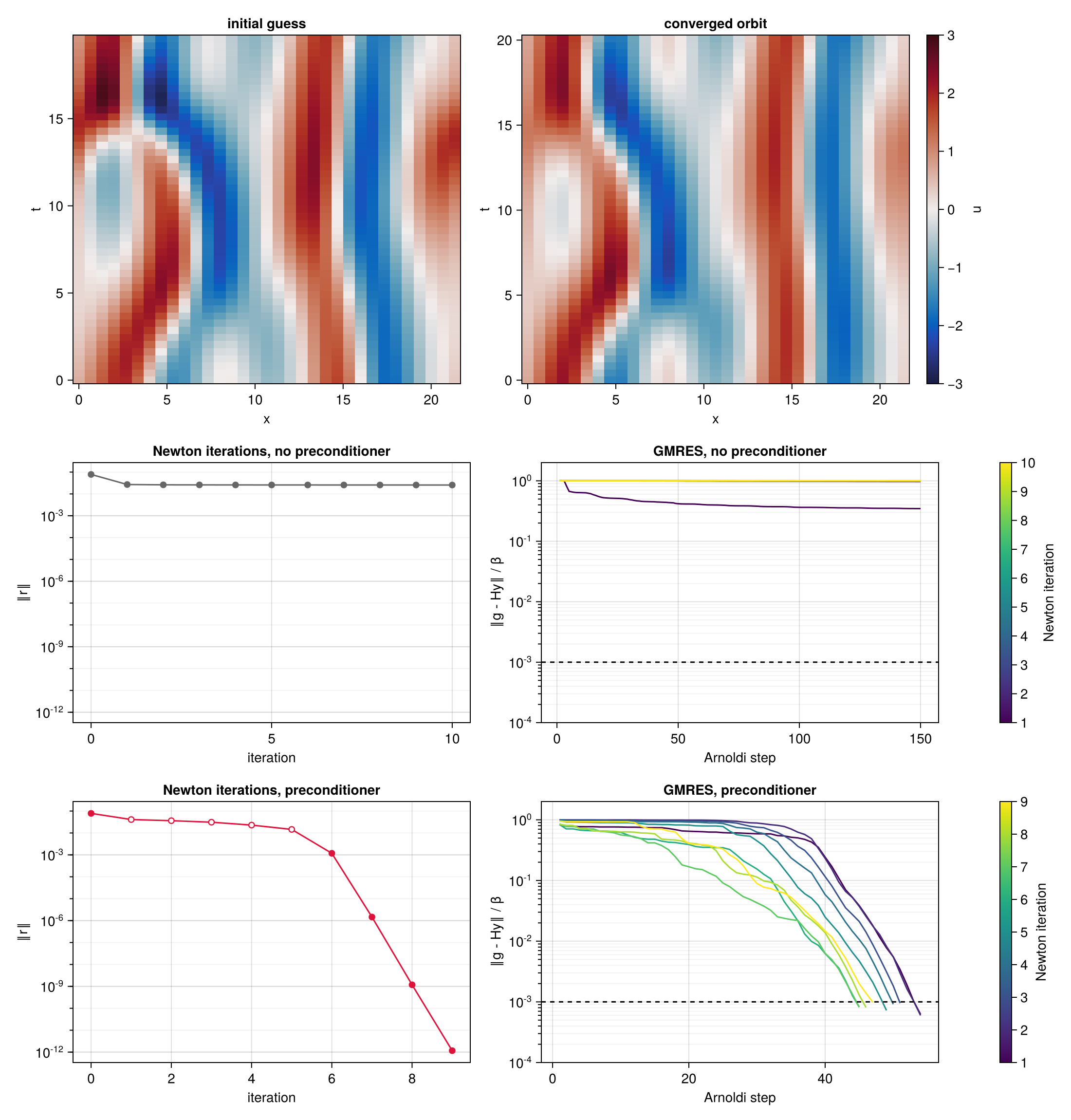
Top: the initial guess and the converged orbit over one period, in the fixed frame. Middle and bottom: the same search without and with the preconditioner; left, the residual against the Newton iterations, with hooksteps on the boundary of the trust region (open symbols) and full Newton steps (filled); right, the relative residual of the GMRES solution of the Newton system against the Arnoldi steps, one curve per Newton iteration, with the tolerance $10^{-3}$ dashed.
Without preconditioner GMRES makes almost no progress on any Newton system: after 150 Arnoldi steps the relative residual is still between $0.3$ and $1$, the Newton steps are poor, and the residual of the orbit stalls. With the preconditioner every Newton system is solved to $10^{-3}$ in 45 to 55 Arnoldi steps. The first five iterations are nonetheless hooksteps: far from the solution the Newton step is longer than the trust region, and only part of it is taken. From the sixth iteration the full Newton step is taken, and the residual drops from $10^{-3}$ to $10^{-12}$ in three iterations. The search costs 441 Jacobian actions.
Size of the problem. On the grid of $33 \times 49$ points in space and rescaled time, the orbit has $33 \times 49 = 1\,617$ field values, the log-frequency and the drift speed: $N = 1\,619$ real unknowns. The search costs 441 Jacobian actions, about a quarter of an action per unknown, each the cost of a few FFTs of the space-time grid. Newton's method with a direct solver would instead form the Jacobian at every iteration, $N$ actions for the $1\,619 \times 1\,619$ dense matrix of the spectral discretisation, and factorise it, about $2N^3/3 \approx 2.8 \times 10^{9}$ operations. A finite-difference discretisation in time makes the Jacobian banded and the factorisation much cheaper, but its cost grows as the cube of the number of spatial unknowns, while the number of Jacobian actions of the preconditioned Krylov solver does not grow with the resolution: see Cost compared with direct solvers for an estimate.
References
- Y. Kuramoto and T. Tsuzuki, Persistent propagation of concentration waves in dissipative media far from thermal equilibrium, Prog. Theor. Phys. 55, 356–369 (1976).
- G. I. Sivashinsky, Nonlinear analysis of hydrodynamic instability in laminar flames — I. Derivation of basic equations, Acta Astronaut. 4, 1177–1206 (1977).
- P. Cvitanović, R. L. Davidchack and E. Siminos, On the state space geometry of the Kuramoto–Sivashinsky flow in a periodic domain, SIAM J. Appl. Dyn. Syst. 9, 1–33 (2010).
Contents
- Usage
- Space-time formulation
- Search by optimisation
- Search by root finding
- Preconditioning
- Lorenz system
- Kuramoto–Sivashinsky equation
- Kuramoto–Sivashinsky in the odd subspace
- L-BFGS against the hookstep
- API
A note on how this package was written
This package was written with AI assistance (Claude, by Anthropic). Developing it would have taken me about two weeks, with a great deal of reasoning, manual derivations and reading. Claude did it in a day. — Davide Lasagna